Mrs Prusik Will See You Now
How Thomas Prusik-Parkin kept his dead mother alive on paper — and in a wig — to collect her benefits and mortgage her house, and what the court record says about it.
Source: Supreme Court, Kings County
A royal commission found that "deep sleep therapy" at a small private hospital in Sydney's north killed at least 24 patients between 1963 and 1979. That is a toll in the range of Australia's worst mass killings. No doctor was ever convicted of anything. Sixty years on, the last chapter was a publisher's apology to one of them. This is the record, and what is still unresolved.
Start with the number, because everything else in this story is an argument about it.
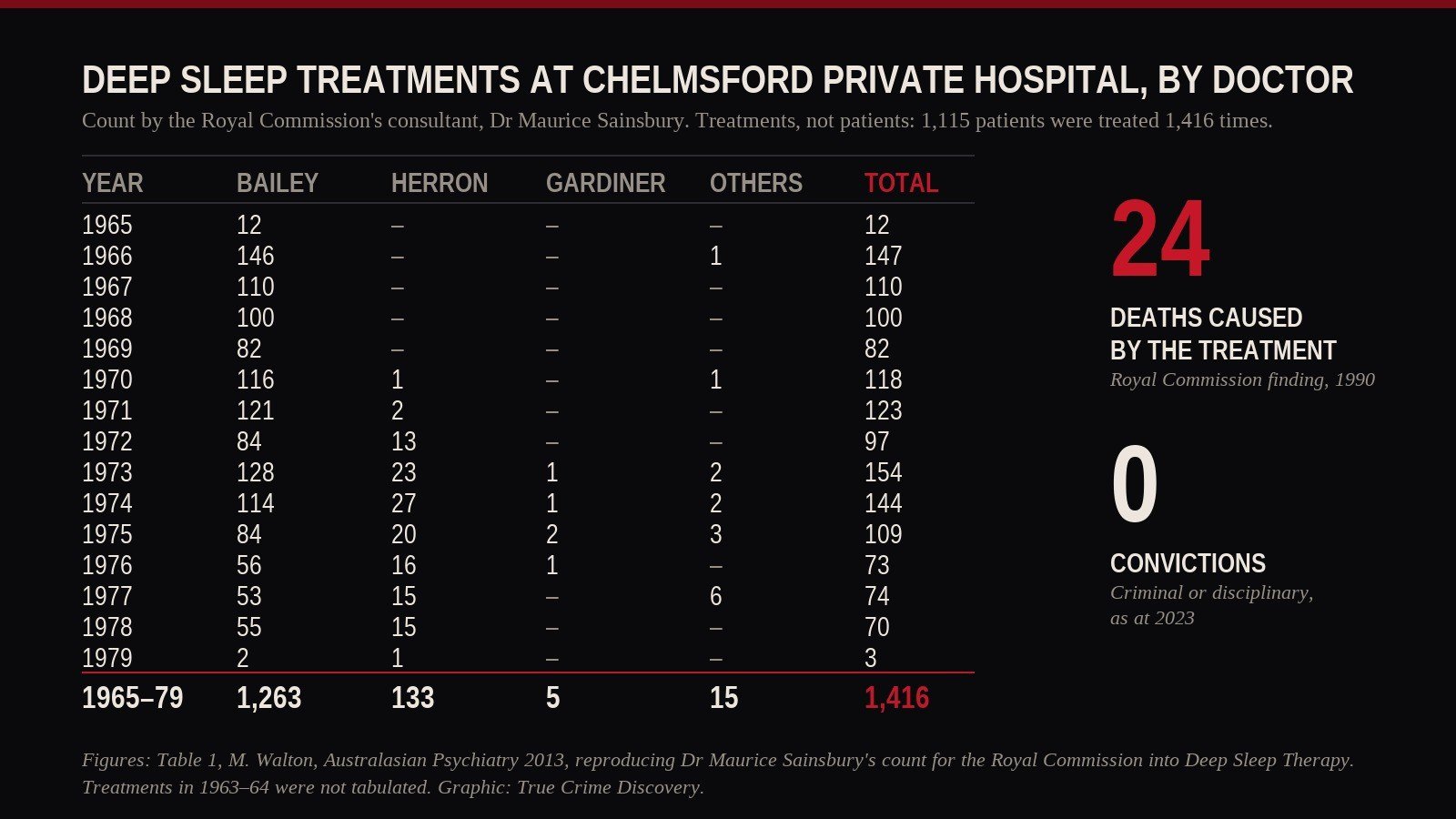
The Royal Commission into Deep Sleep Therapy, which sat for close to two years from 1988 and reported in December 1990, concluded that there were at least 24 deaths caused by the treatment at Chelmsford Private Hospital, Pennant Hills, between 1963 and 1979. It counted another 24 former patients who took their own lives within a year of leaving. A respiratory physician who went through the death certificates for the commission found 26 people who died during or immediately after the treatment, nearly half of them under 40.
Twenty-four is a toll that stands with the worst mass killings in modern Australian history. Port Arthur, in 1996, killed 35. The dead of Chelmsford were not shot. They were put to sleep, in a licensed hospital, by registered doctors, and most of them were certified as having died of natural causes.
Nobody was ever convicted of anything.
The man who invented the treatment, the psychiatrist Harry Bailey, killed himself in 1985. The only manslaughter charge ever laid, against him over one patient's death, had already been dismissed at committal for lack of evidence. His three colleagues were never charged over the deaths of their own patients. The disciplinary cases against them were stayed by the courts because the Health Department had taken so long to bring them, and the High Court upheld those stays in 1993. And when, decades later, two of the surviving doctors sued a publisher over a book chapter that called the hospital a horror, the only court that ever weighed the whole of the evidence found the chapter substantially true, was overturned on appeal over the evidence it had used, and the case ended in 2023 with the publisher apologising and paying the last surviving doctor an undisclosed sum.
This is Part 1 because the file is not closed. What follows is what the record actually says, drawn mainly from the 915-paragraph Federal Court judgment of 2020, which is the fullest public account of Chelmsford that exists outside a royal commission report nobody has put online.
The judge who heard the 2020 case, Justice Jayne Jagot, dealt with the name first. "The reference to DST as involving 'sleep' and 'therapy'," she wrote, "on the evidence in this case, is a misleading euphemism."
What the patients got was a barbiturate coma. On admission a nurse, not a doctor, injected 500 milligrams of sodium amytal. Once the patient was unconscious they were wheeled to the sedation ward, a tube was passed through the nose into the stomach, and for the next ten to fourteen days a nurse crushed tablets and put them down the tube every four hours: Tuinal, a barbiturate, at 200 to 400 milligrams a dose, with tranquillisers and antipsychotics on top. When a patient became rousable at the end of a dose they were dosed again. Bailey, who had introduced the treatment to Chelmsford in 1963 and claimed an 85 per cent success rate for it, told the nurses that a patient who opened their bowels was not sedated deeply enough.
The drug sheet was a pre-printed form. It set the same drugs and the same dose ranges for every patient regardless of age, weight or physical condition, and it was signed by Bailey or Herron in bulk, so the nurses could take one from the drawer and write a name on it. The hospital's files included a treatment sheet for a 14-year-old girl and one for a 13-year-old.
While the patients were under, they were given electroconvulsive therapy, usually every day but Sunday, by Herron or Dr Gardiner. The accepted practice of the day was to give ECT with an anaesthetic, a muscle relaxant and oxygen. At Chelmsford, the judge found, it was routinely given without any of them. One nurse described a doctor applying shocks until the patient's body "lifted off the bed so that they were balancing on the back of their head and the heels of their feet and the patient screamed."
A clinical pharmacologist told the court the only accepted use for barbiturates in those quantities was to induce a coma in an intensive care unit after a severe head injury. The daily doses at Chelmsford, he said, were "similar to or very significantly exceed the doses associated with severe toxicity." With barbiturates the margin between sedation and death is narrow, and the regime, the judge wrote, "was akin to an ongoing gamble with the lives of patients."
There was never a doctor on the premises. On the night shift one registered nurse was responsible for the whole hospital, with one or two assistants, and they sat in the doorway of the sedation ward so they could hear. Observations were taken every four hours. If something went wrong, the rule was to telephone the treating doctor, or Dr Gill, who part-owned the hospital and lived ten to twenty minutes away, and to send nobody to a real hospital without a doctor's say-so.
The patients were naked, on their sides, with a tube in one nostril. They were not catheterised; they wet the bed, and the sheets were changed when a nurse noticed. Some were strapped at the wrists. Visitors were banned from the sedation ward, and families who rang were, as a matter of practice, told their relative was sleeping or doing well.
One matron lasted five months before she resigned. She told the court she had never, before or since, seen barbiturates prescribed in such quantities. She read the hospital's death-certificate book and noticed how young the dead were. She instructed her nurses to stop the drugs and lighten any patient whose temperature rose above 37.5 degrees. When she told Bailey, he ordered the patient kept under; when she did not tell him, he had another nurse re-sedate them. She took her concerns to Gill. He laughed, she said, and told her she was overreacting.
The judge did not blame the nurses. They were, she found, "being asked to perform an impossible task": to run safely, by eye, a drug regime "which a qualified anaesthetist in an intensive care unit would have had difficulty in managing."
Herron had agreed with the numbers under oath at the royal commission. Asked whether he knew that at least 26 people had died during or immediately after sleep therapy, and that in the overwhelming majority of cases the treatment was probably the cause, or at least a significant contributing factor, he answered yes to both. In the Federal Court, forty years on, he said he had changed his mind. The judge preferred the earlier answer.
A 66-year-old woman with a long history of alcohol abuse and depression was admitted under Herron in March 1976. He was not there. He ordered deep sleep by telephone, and it began at 2pm the day she arrived, before her blood test results were back. In about 36 hours she was given 3,600 milligrams of barbiturates. The next morning Herron gave her ECT with an anaesthetic but no muscle relaxant and no oxygen. At 1.30am the following day a nurse gave her another 400 milligrams of Tuinal; she snored loudly, then stopped. Herron signed the death certificate himself and gave the cause as a heart attack. The law of the day forbade a doctor to certify a death within 24 hours of an anaesthetic. The pathologist found no evidence of a heart attack. The judge found the certificate was falsified to avoid an inquest.
A 25-year-old man, a drug addict, was Gill's own patient. At 8am one morning he was grey but breathing, so nothing was done. By 8.25 he had no pulse. The nurses could not revive him. An anaesthetist who happened to be arriving at the hospital for other work intubated him on the floor of the ward, and he was taken to Hornsby Hospital, where he died a week later. Gill gave another patient the same treatment within a month.
A 26-year-old woman was admitted under Bailey in July 1977. Her blood pressure fell to a dangerous level within hours of the first dose and stayed there for two days. Over the next ten days she vomited dark, foul-smelling fluid, ran a temperature and a pulse over 140, stopped passing urine and developed a grossly distended abdomen. She was kept at the maximum dose of Tuinal through nearly all of it. When a night sister rang the matron three times in two hours about her, Gill telephoned the sister and told her, the sister said, to stop making a fuss or it would be better if she did not work there. The woman was lightened, given two more ECTs by Herron without a muscle relaxant, and died of a cardiac arrest on 12 August. Her death certificate, signed by Bailey, gave the cause as a pulmonary embolus. The psychiatrist who reviewed her notes thought the likeliest cause was a bowel obstruction brought on by the treatment. It was her death over which Bailey was charged with manslaughter, and over which the charge failed.
A professor of psychiatry told the court that in any hospital one death under a treatment should trigger an investigation, a second should suspend it and a third should end it. Chelmsford went on until 1979.
The most famous of the survivors was Stevie Wright, the singer of the Easybeats, who was treated at Chelmsford by Bailey for drug addiction in the 1970s and talked about it for the rest of his life; it is told at length in the 1999 biography written with him. He died in 2015. He is named here because he chose to tell his own story. The other patients in this article are not.
The court heard from several of them. A 37-year-old actor and gym owner, anxious about a cosmetic operation he thought had gone wrong, was admitted under Herron in February 1973. He refused to sign for ECT. He was given two barbiturate tablets anyway, then the injection, and kept under for ten days. He was shocked six times. He came round in pain, strapped to the bed, hallucinating and coughing blood, and was transferred to Hornsby Hospital with pneumonia in both lungs and a clot in a lung; the psychiatrist who later examined him put his chance of survival on arrival at fifty-fifty. When his records were finally produced, the bottom of his admission sheet, where the ECT consent should have been, had been cut off and replaced with a photocopy of an X-ray form. A former nurse told the court about a meeting in about 1978, with Gill, Herron and the receptionist present, at which it was discussed how to disguise the fact that the form was unsigned. The judge believed her. A civil jury had found Herron liable for false imprisonment, assault and battery over this patient back in 1980.
An 18-year-old, taken to Chelmsford by his aunt, remembered patches on his head and "great bolts of electricity," being strapped down, chewing through leather straps, and waking to hallucinations of severed body parts hanging from the ceiling. A woman who later became a psychologist lost two stone in a fortnight and found out afterwards she had been given ECT. Another wrote "do not give me ECT" over and over on a pink sheet of paper that turned up in her file. There was no consent form for deep sleep at all.
Chelmsford was not hidden. The Health Commission inspected it every year and renewed its licence. In 1971 its Poisons Branch recommended that a standard written drug regime be provided for "narcotherapy," and the pre-printed sheet that followed was the one the nurses used until the end. Coroners held inquests into some of the dead; Bailey gave evidence at them. Doctors referred patients for sixteen years.
The judge's answer to the inspections was short. If the inspectors were doctors and knew what the treatment involved, "the only conclusion open on the evidence is that those medical practitioners from the Health Commission were in gross dereliction of their duty." And then: "The negligence of others does not excuse the applicants."
The story broke from outside the system. A 60 Minutes program called The Chelmsford File, built on hospital records that a nurse who was also a Scientologist had copied out of the hospital's rubbish bins, and a decade of campaigning by former patients, produced the royal commission in 1988. By then it was too late for the law. Disciplinary complaints against Herron were stayed by the NSW Court of Appeal in 1986. Fresh complaints after the commission were stayed again in 1991, and in 1993 the High Court let that stand. The Chief Justice of New South Wales, in the 1991 decision the High Court upheld, put the two halves of it side by side: "The allegations against the claimants are serious and they are supported by the findings of the Royal Commission. On the other hand, the delay in bringing the complaints was both extreme and unjustifiable." The department's own delay, not the strength of the case, is what ended it.
Herron was struck off in the late 1990s, for conduct unconnected with Chelmsford. Deep sleep therapy itself was banned by amendment to the New South Wales Mental Health Act in 1983, and remains a named prohibited treatment today. That is the whole of the official reckoning.
In 2016 HarperCollins published Steve Cannane's book on Scientology in Australia. One chapter told how the Scientologist nurse's records had helped bring on the commission, and spent a few pages on what the hospital had done. In 2017 Herron and Gill, both in their eighties, sued.
They did not argue they had been misreported. They argued the royal commission had been wrong: that it had been "hoodwinked into accepting a 'Church of Scientology version of events'," that deep sleep was a legitimate treatment with a respectable literature, that the patients who complained were liars and fantasists, and that the nurses had managed the drugs safely. They called no medical expert to say so. The six experts who did give evidence, the judge wrote, "speak with one voice": by the 1960s, with modern drugs available, coma treatments were outmoded and unjustifiable outside a properly run clinical trial, and what was done at Chelmsford "was unethical, grossly negligent and involved sustained medical malpractice by reference to the applicable standards at the time."
On the doctors as witnesses she was blunt. Their evidence was "driven by their need for vindication." Gill, she noted, had moved the hospital's records to a squash court near Newcastle to keep them from a search warrant, and had secretly taped a nurse. Herron, at 87, was hospitalised during his cross-examination; she made allowance for that, and still found his account of the treatment's dangers "far from reality."
She found every meaning the book carried about the doctors substantially true, bar one the publisher had already withdrawn. She found that Herron's gross negligence had nearly killed the actor; that both doctors kept using the treatment knowing it was killing people; that both had a hand in false death certificates; that the hospital lied to families and kept them out; and that the treatment traumatised many patients who never consented to it. She dismissed both cases with costs on 25 November 2020.
Herron died on 7 February 2021, six weeks after the appeal was lodged. His estate was insolvent and his son declined to administer it, so his case died with him. Gill, who had funded both cases, carried on alone.
On 29 April 2022 three judges of the Full Court of the Federal Court, Justices Rares, Wigney and Lee, set the judgment aside in 655 paragraphs of their own. They did not find that anything the trial judge had described was untrue. They found that the trial had used evidence it should not have, and that her findings could not be separated from it.
Two kinds of evidence were the problem. The first was the doctors' own testimony to the royal commission. They had been compelled to give it, under a law that promised it could not be used against them in any later court. The trial judge had held that promise did not cover a case the doctors themselves had brought. The Full Court said she had read the protection too narrowly, and that she should at least have weighed, item by item, whether to exclude that material. Her findings against both men's credibility, the court noted, "drew heavily" on it, including Herron's admission at the commission that 26 people had died.
The second was the reports of four doctors who had written for the royal commission in 1989 and had since died: a respiratory physician who analysed the death certificates and three specialists who reviewed individual deaths. None had been cross-examined, then or since. The Full Court held their reports did not meet the modern test for expert evidence and should have been kept out. One of them, the death-certificate analysis, was the main basis for the trial judge's finding that the treatment caused at least 23 deaths, and that finding ran through everything else. It was, Justice Lee wrote, "impossible or unrealistic for the Full Court to unscramble the egg."
The court also gave weight to a point the doctors had made from the start. They had never been able to contest the royal commission's findings, because by the time the commission sat the courts had already stayed the disciplinary cases for the department's delay. Justice Rares added a sentence worth keeping: "However distinguished a Royal Commission may be, experience has shown that clear or conclusive findings that one makes often are not vindicated in subsequent judicial proceedings, whether criminal or civil." For the same reason the court threw out the publisher's other defence outright. The author had known about the stays and the absence of any criminal charge, had put none of it in the book, had asked neither doctor for comment, and had written that "the Chelmsford doctors continued to avoid accountability for their actions." That, the court held, was not reasonable.
Some of the trial findings survived. The Full Court left standing the judge's acceptance of the patients and relatives who gave evidence, and of the former nurse's account of the meeting about the cut-off consent form. It set aside the findings that Herron had falsified a death certificate and overcharged for anaesthetics he did not give, and that Gill was party to a false certificate, as resting on "fairly tenuous inferences" and on the excluded evidence. Justice Wigney called the result regrettable but unavoidable. The court ordered a new trial on whether eight of the book's meanings about Gill were true, including that the treatment killed his patients and that he kept using it knowing so.
The retrial never happened. On 3 July 2023, on the eve of the new hearing, Gill reached a confidential settlement with HarperCollins. The publisher apologised in court and paid him an undisclosed sum.
So the last word in the record, as it stands, is an apology from a publisher to a doctor who ran the hospital where 24 people died. Not because the 2020 judgment was shown to be wrong about what happened in the sedation ward, but because the evidence that proved it had been gathered by a royal commission under the commission's rules, forty years earlier, from witnesses who were now dead and doctors who had been compelled to speak, and a defamation court in 2020 could not use it the same way.
This file stays open. These are the gaps, and we will fill them as we can.
This article is drawn from the published reasons for judgment of Justice Jagot in Herron v HarperCollins Publishers Australia Pty Ltd (No 3) [2020] FCA 1687; quotations are from that judgment, including evidence and earlier court findings quoted in it. That judgment was set aside by the Full Court in Herron v HarperCollins Publishers Australia Pty Ltd [2022] FCAFC 68, from which the account of the appeal is drawn; the 2023 settlement is described from press reporting, cited below, as its terms are confidential. Patients are not named, with one exception: Stevie Wright, a public figure who told his own story in a biography written with him. The doctors are named as the judgment names them. The report of the Royal Commission into Deep Sleep Therapy is not available online.
Primary = the investigating or custodial authority's own published record. Links open in a new tab. Last checked 17 November 2026.
How Thomas Prusik-Parkin kept his dead mother alive on paper — and in a wig — to collect her benefits and mortgage her house, and what the court record says about it.
How Amador Cortes-Meza lured girls from Mexico with promises of marriage, forced them into prostitution near Atlanta, and was jailed for 40 years.
The only unsolved air piracy in American commercial aviation history — the ransom, the parachutes, the jump, and the $20 bills that turned up nine years later.